CurrentSky · AISHIP
Flight Computer
Every correction at the perfect moment.
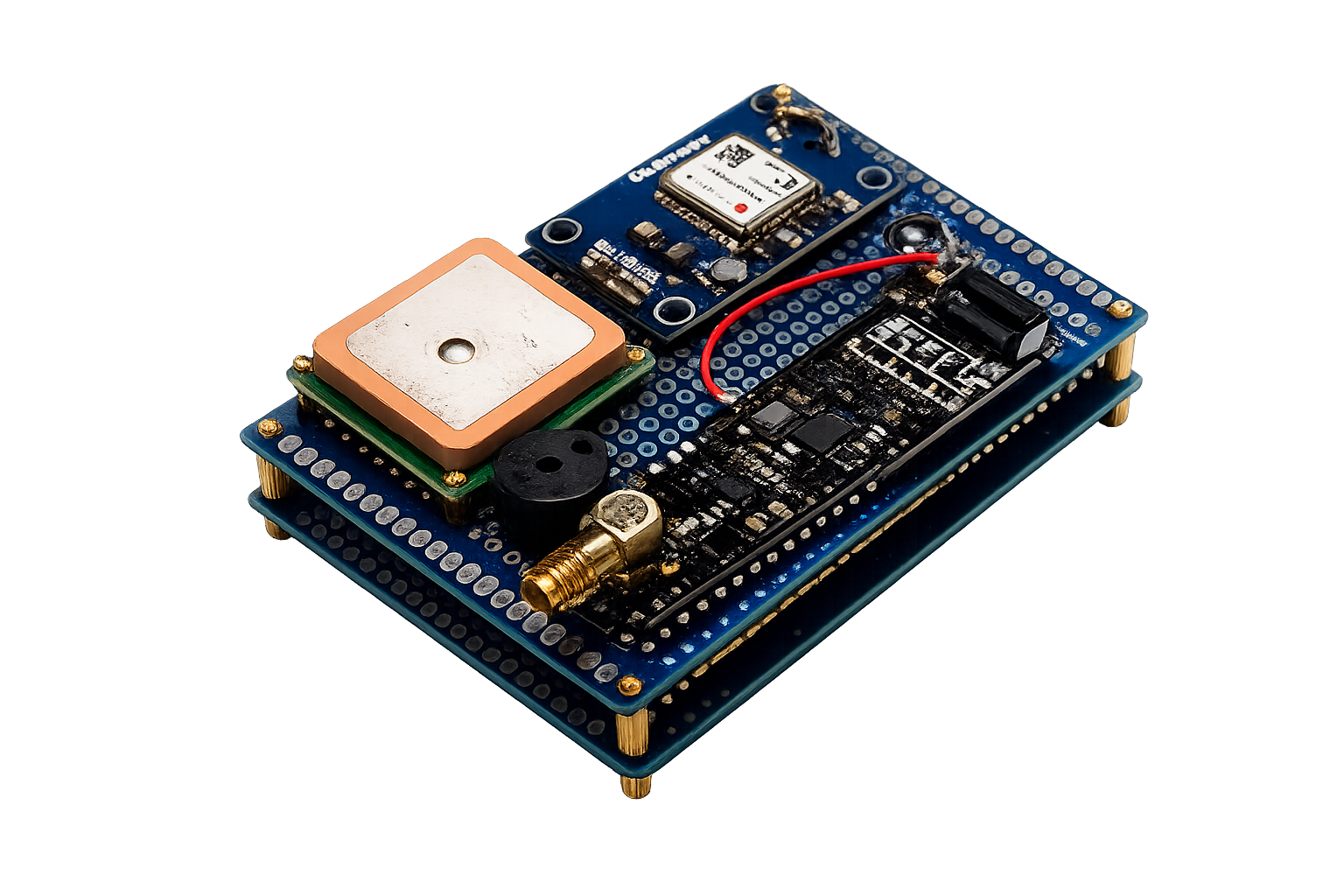
KAIROS is the custom flight computer that keeps AISHIP stable in the air — sensing, deciding, and acting hundreds of times a second.
What is KAIROS
A computer built for balance
Where a normal drone spreads its motors wide for stability, a thrust-vectored rocket balances on its own thrust like a pencil on a fingertip — it must actively correct its attitude many times a second to stay upright. KAIROS is the on-board intelligence that turns raw sensor data into precise control commands in real time, continuously and autonomously.
The name
The Greeks had two words for time. Chronos is measured time — the ticking of a clock. Kairos (καιρός) is the opportune moment, when everything lines up and action matters most. A flight controller lives entirely in kairos: hundreds of perfectly-timed decisions per second.
CurrentSky → AISHIP → KAIROS
How it works
Sense. Decide. Act.
01
Sense
A 9-axis motion sensor fuses gyroscope, accelerometer, and magnetometer into a single drift-corrected picture of how the vehicle is oriented in 3D space.
02
Decide
A real-time controller compares actual attitude against the target and computes the exact correction — fast enough to cancel a tip-over before it becomes a fall.
03
Act
KAIROS steers the direction of thrust to hold balance and course — then loops back to sense, hundreds of times every second.
Capabilities
What it does
Active stabilization
Continuous high-rate attitude correction keeps a thrust-vectored vehicle upright.
Autonomous navigation
Flies point to point on satellite positioning, altitude held by barometric sensing.
Live telemetry
Streams flight data to the ground in real time over a wireless link.
Flight recorder
Logs the complete flight to onboard storage — a black box for analysis.
Battery intelligence
Monitors pack voltage and can trigger a safe landing before over-discharge.
Safety monitoring
Watches for abnormal conditions and can execute a controlled abort.
Locator beacon
An audible finder to recover the vehicle after landing.
Companion app
A desktop app for tuning, live monitoring, and reviewing recorded flights.
In the lab
Built, not rendered
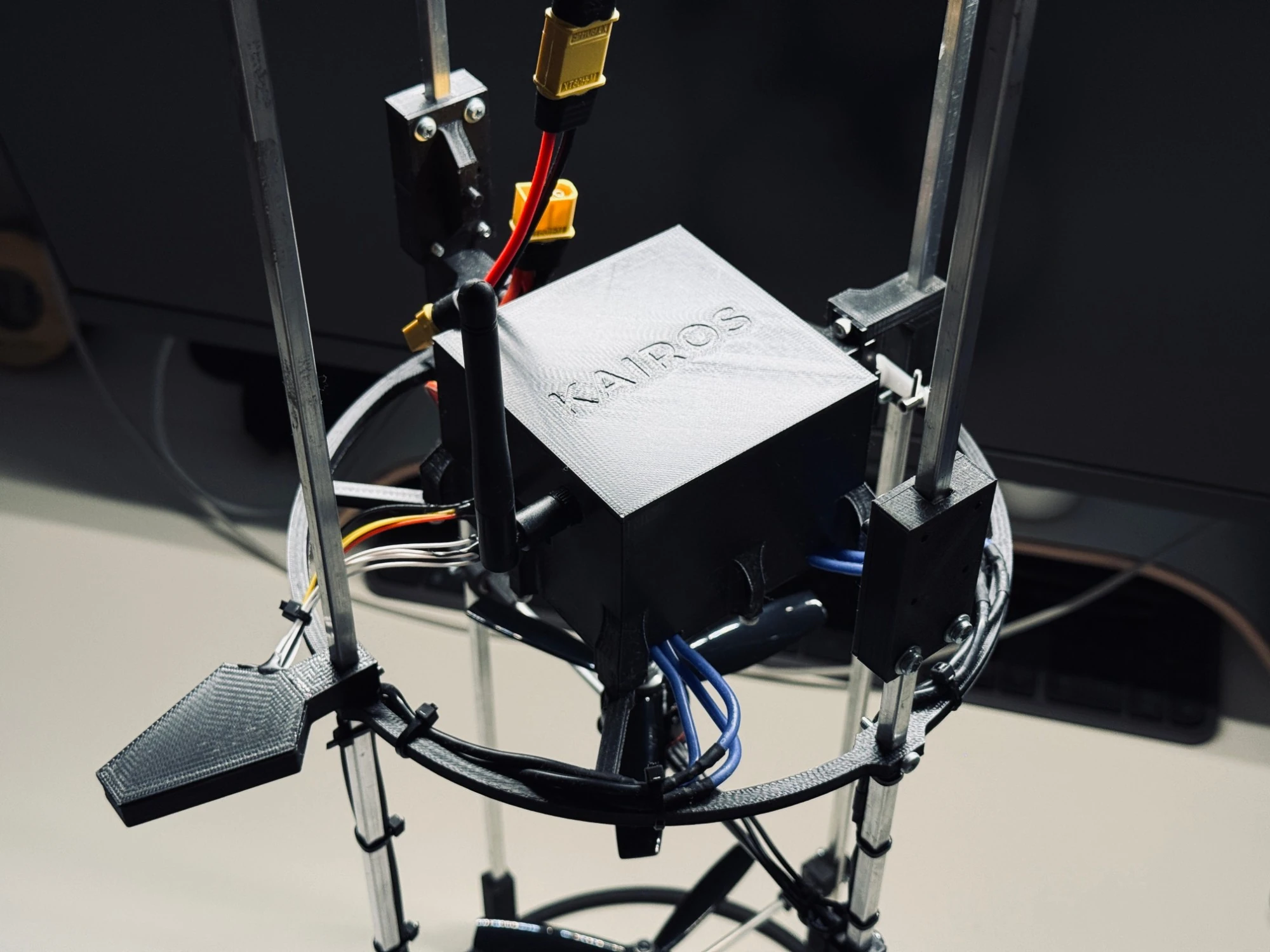
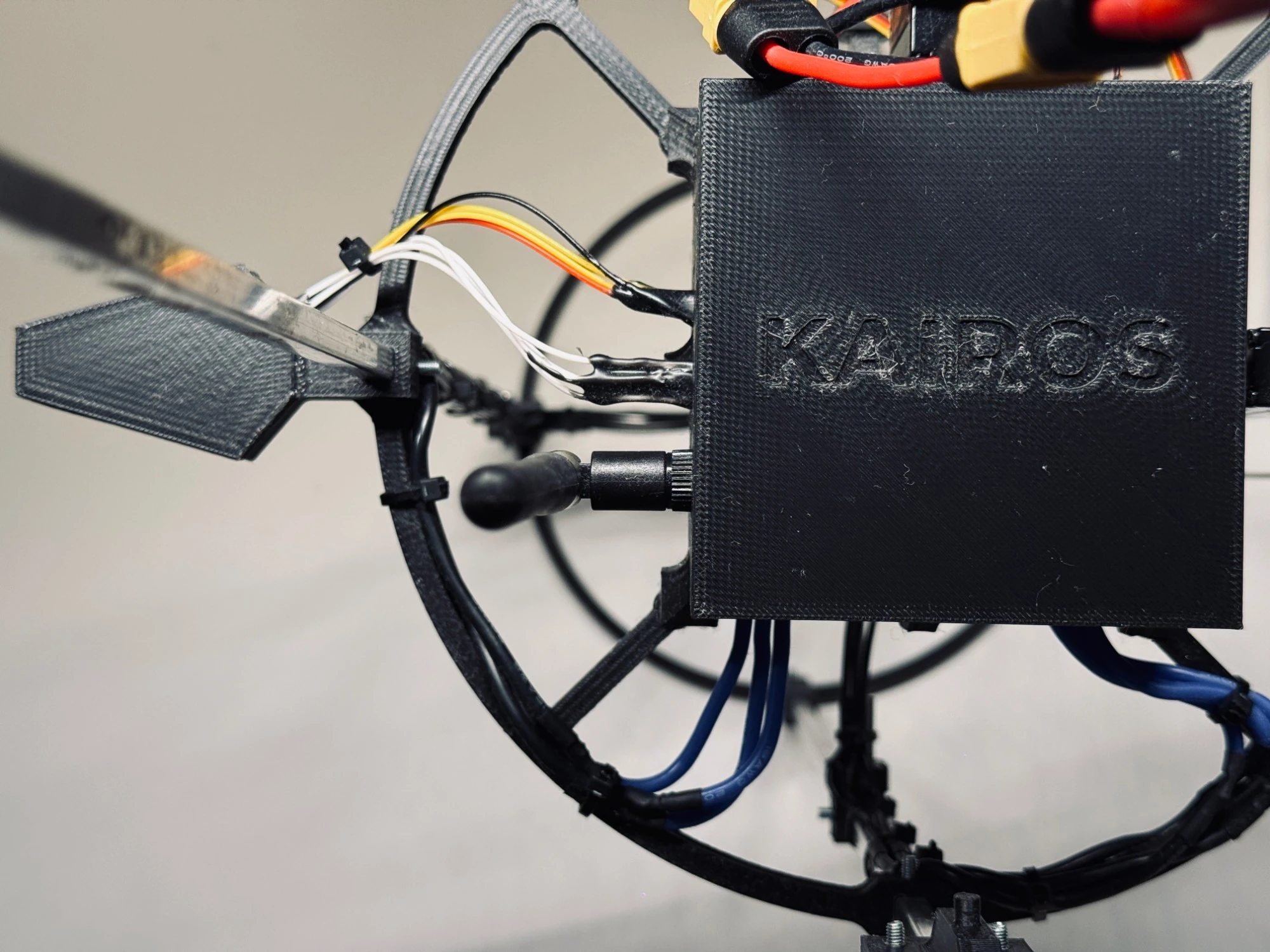
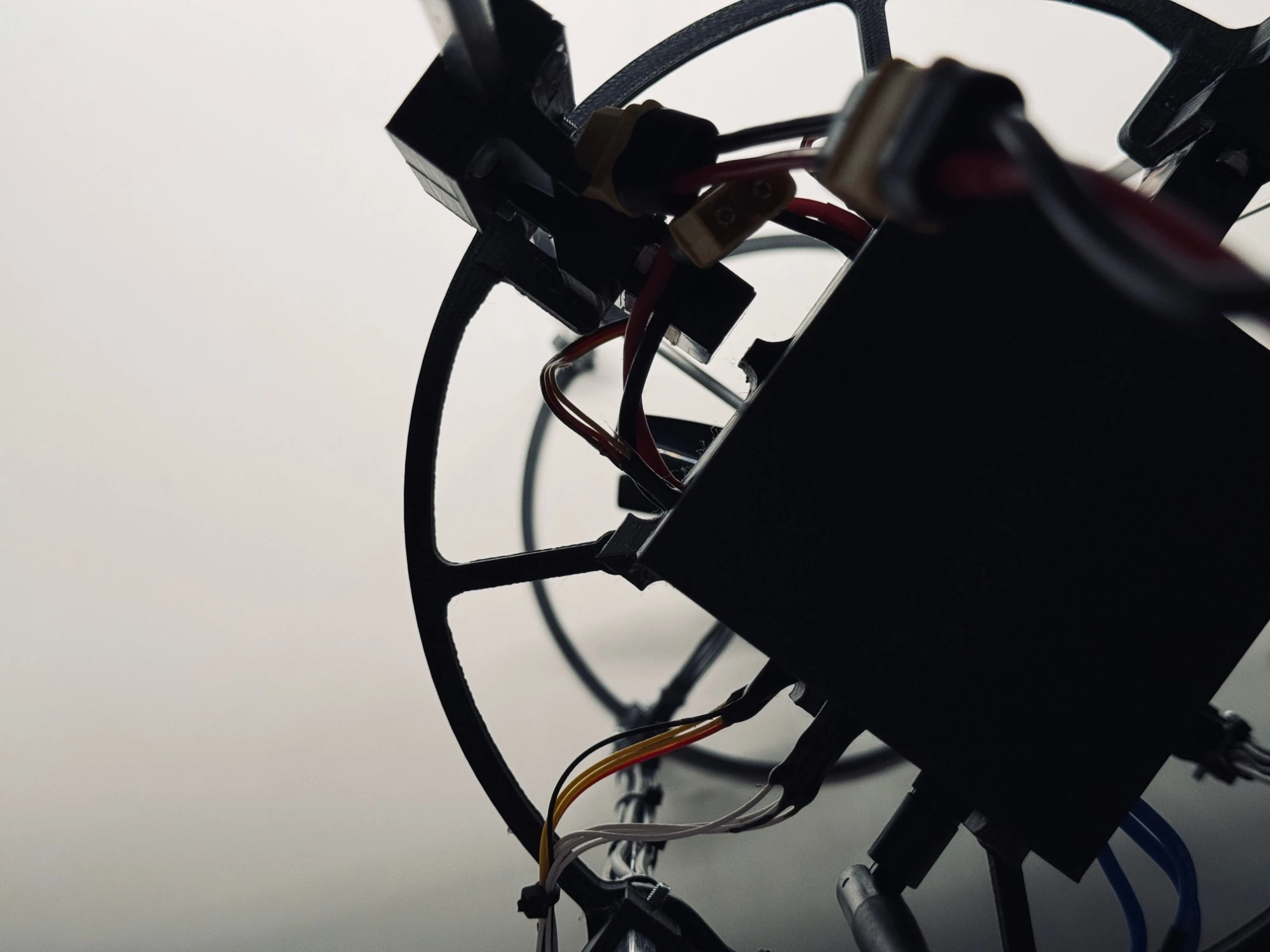
The real KAIROS on our bench: the board sealed in its printed enclosure, the harness routed along the frame ring, and every connector where the flight needs it.
Inside
Wired by hand, layer by layer
Take the cover off and KAIROS is a stack of hand-soldered boards: the processor, the motion sensor, the GPS receiver and the long-range radio, each wired and tested on its own before it joined the stack.
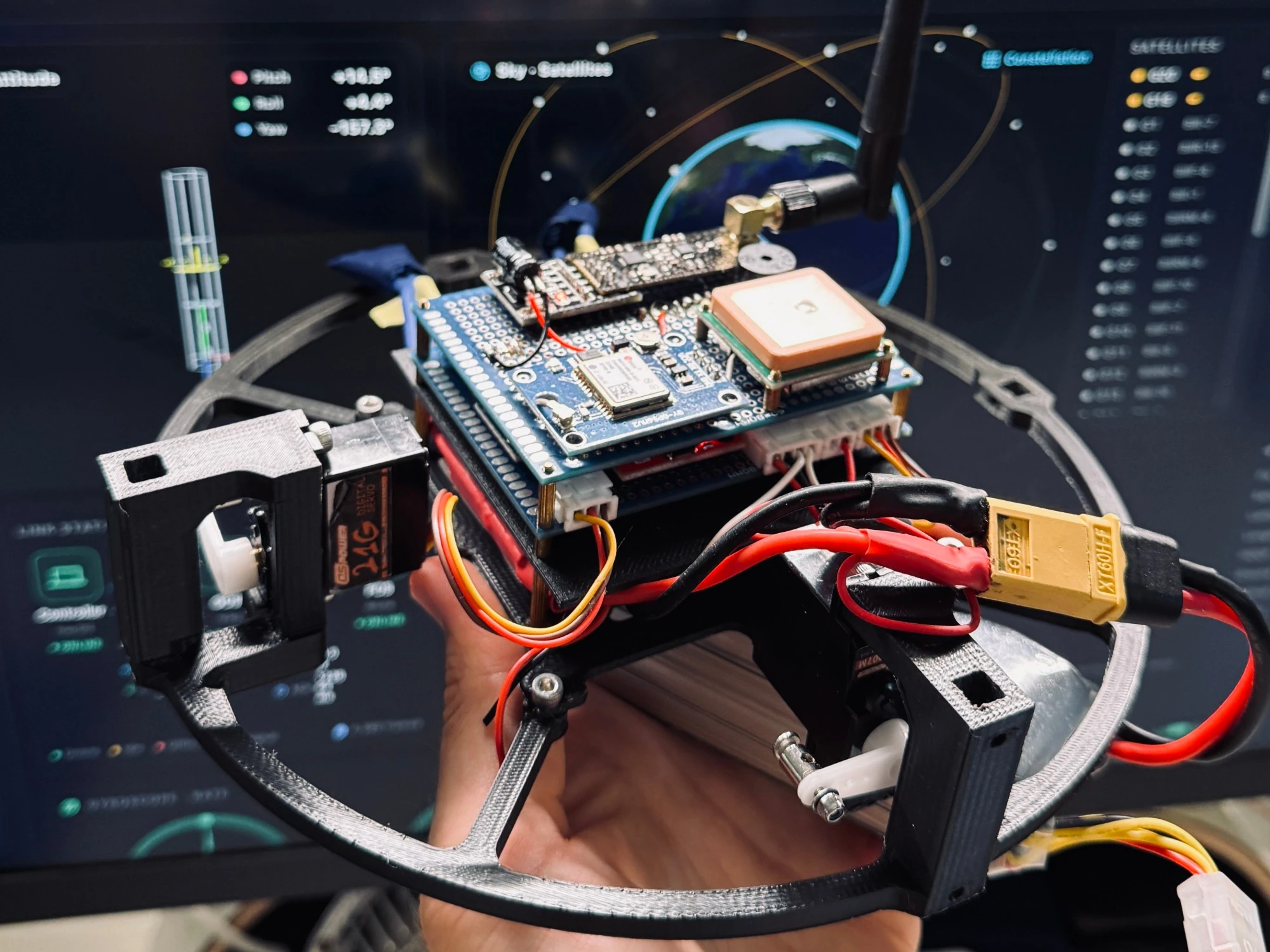

Under the hood
Specifications
| Class | Custom flight computer for thrust-vectored / experimental flight |
| Processor | 32-bit ARM Cortex-M7, 600 MHz |
| Control rate | Hundreds of correction cycles per second |
| Orientation | 9-axis motion sensor with on-chip fusion |
| Altitude | Barometric pressure sensor |
| Position | Satellite navigation (GNSS) |
| Connectivity | Wireless telemetry link |
| Logging | Removable onboard storage (flight recorder) |
| Software | Native desktop companion app |
| Design | Built in-house by CurrentSky |
Why we built it
A different problem
Off-the-shelf controllers are built for multirotors — inherently stable, well-served by existing firmware. Thrust-vectored flight is different: fewer motors, an unstable balance point, control through steering thrust rather than differencing it. It demands a controller tuned end to end. KAIROS is our answer — designed from the first principle of thrust-vectored control and iterated in-house, so every layer is ours to refine.
The vision
One system, many vehicles
Most controllers are built for one thing — a multirotor controller flies multirotors, a rover controller drives rovers. KAIROS is designed to break that boundary: one universal core that installs into vehicles of completely different shapes and controls each from the same intelligence. Not a new autopilot for every machine — one adaptable system that learns the vehicle it’s placed in.
Air · thrust-vectored
Holds a rocket upright
Steers a single line of thrust and the motors to keep the vehicle balanced — like a pencil on a fingertip. This is AISHIP, the first platform.
Ground
Drives over rough terrain
Turns wheels or coordinates limbs for precise, stable motion across uneven ground.
Water
Holds heading on the water
Keeps position and heading against current and wind, and transitions between water and land.
Transitional
Flies, lands, then drives
The hardest case: one vehicle that moves between domains, controlled continuously through every transition by the same core.
AISHIP is the first platform to prove it — the hardest kind of vehicle to control, and the ideal proving ground. If KAIROS can hold a thrust-vectored drone steady, the same core extends outward to simpler, more varied machines.
Precision
Accurate, repeatable control — holding attitude, position, and trajectory tightly.
Speed
A real-time loop fast enough to catch and correct instability before it grows.
Adaptability
Reconfigurable for a new vehicle, and able to adjust to a changing environment on the fly.
Ecosystem
Part of a larger system
CurrentSky
The company building it.
AISHIP
The thrust-vectored rocket KAIROS flies. See AISHIP V3 →
KAIROS
The flight computer at its core.
Companion app
Desktop tuning, telemetry, and flight review.