CurrentSky · AI agents for drug trials
A pathologist for failed drug trials
AI agents that explain why a cardiovascular drug trial failed, or is likely to fail, and what that means for every other drug on the same target.
The problem
Half of them miss. The answer takes years.
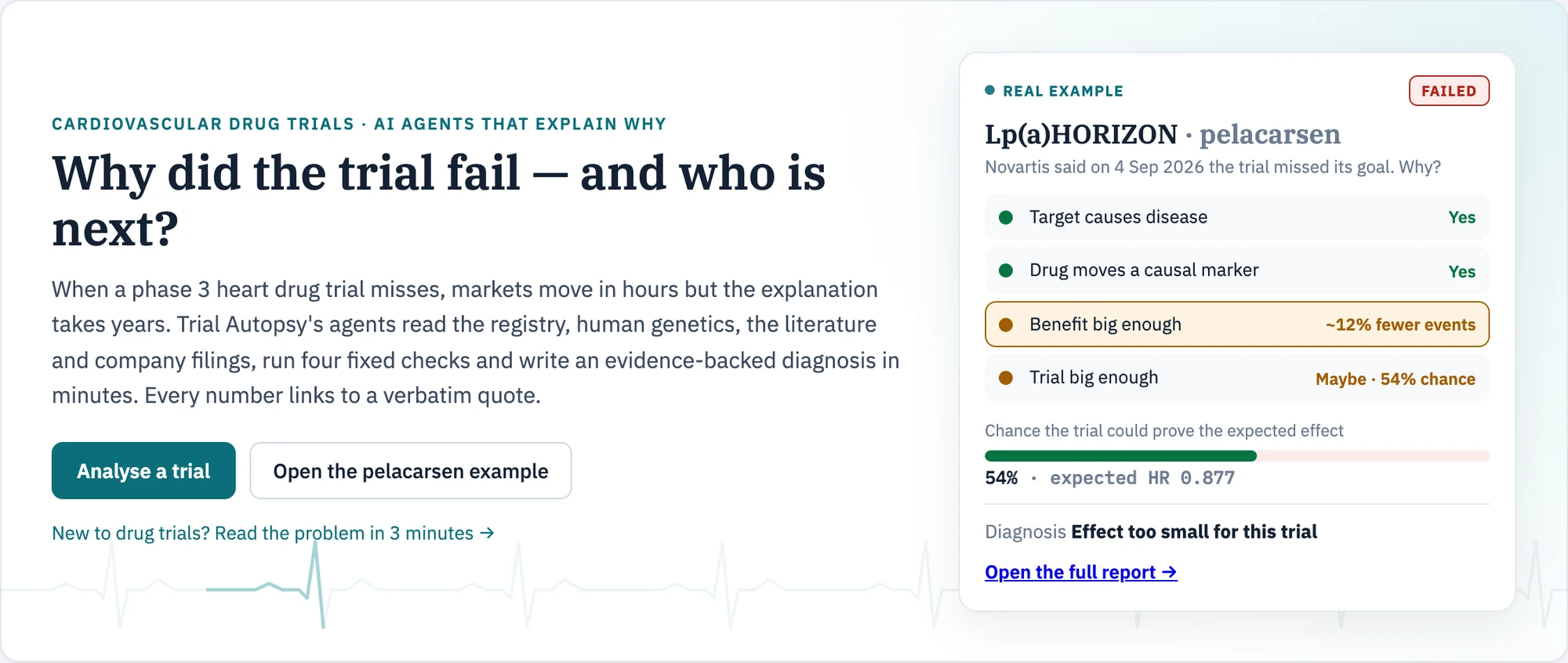
Roughly half of phase 3 cardiovascular outcome trials miss their primary endpoint, and markets move within hours. On 4 September 2026 Novartis said pelacarsen (Lp(a)HORIZON) missed; Amgen, with a drug on the same target, lost about 10% within days.
Everyone asks the same question: did the drug fail, did the trial design fail, or is the biology wrong? That explanation usually takes years. The CETP inhibitors failed in 2012; the genetic explanation came in 2017.
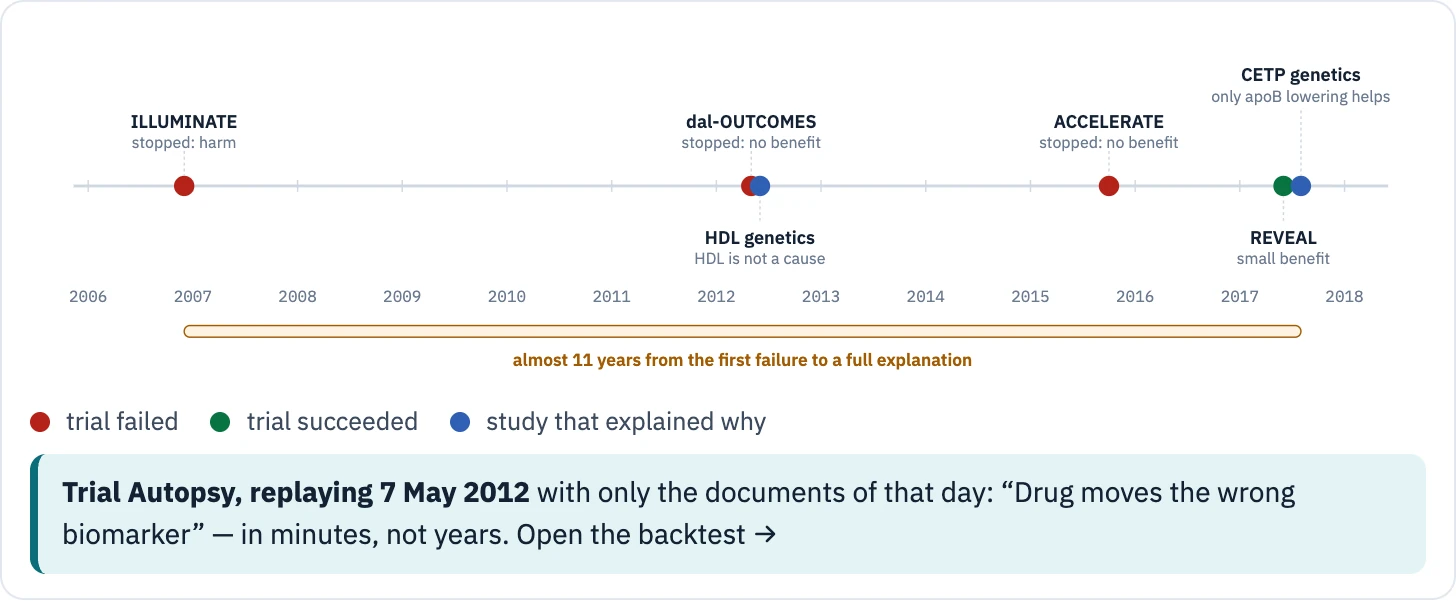
Explanations have historically arrived years after the readout.
How it works
It works like a pathologist
01
Collect evidence
Agents read the trial registry, human genetics, the literature and company filings.
02
Run fixed tests
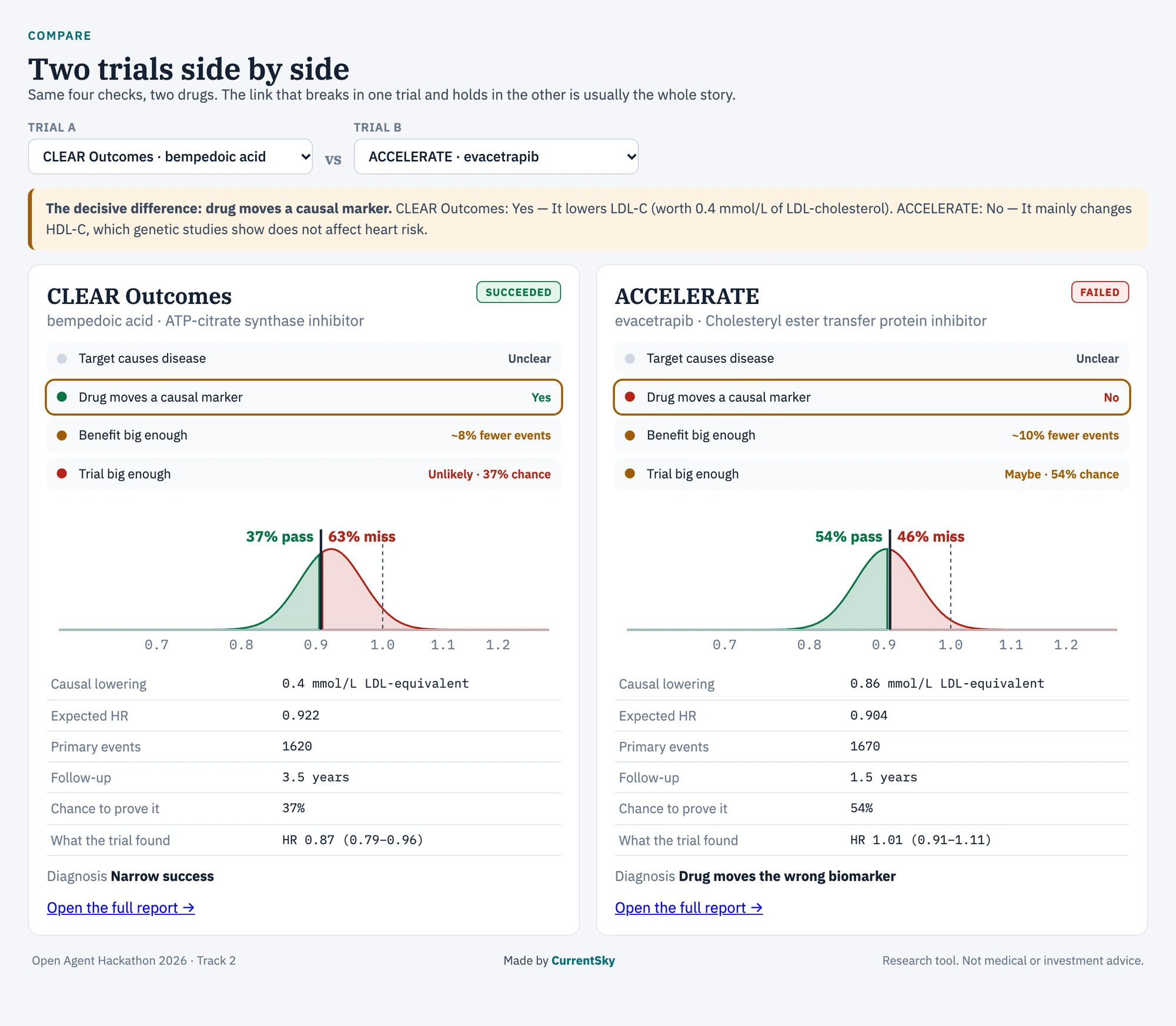
Four checks with their numbers, built into one causal chain from target to trial.
03
Weigh the differential
Every competing explanation is kept, with the evidence for and against it.
04
Write the report
A verdict and the main cause, where every number links to a verbatim quote from its source.
Autopsy
Why did the trial fail, or succeed?
Forecast
What is the risk, and where is the weakest link?
A ClinicalTrials.gov ID, plus the topline press release if there is one.
- A verdict and the main cause
- Four checks with their numbers, as one causal chain
- Every competing explanation, with evidence for and against
- Forecasts for rival drugs on the same target
- Every fact with its verbatim quote
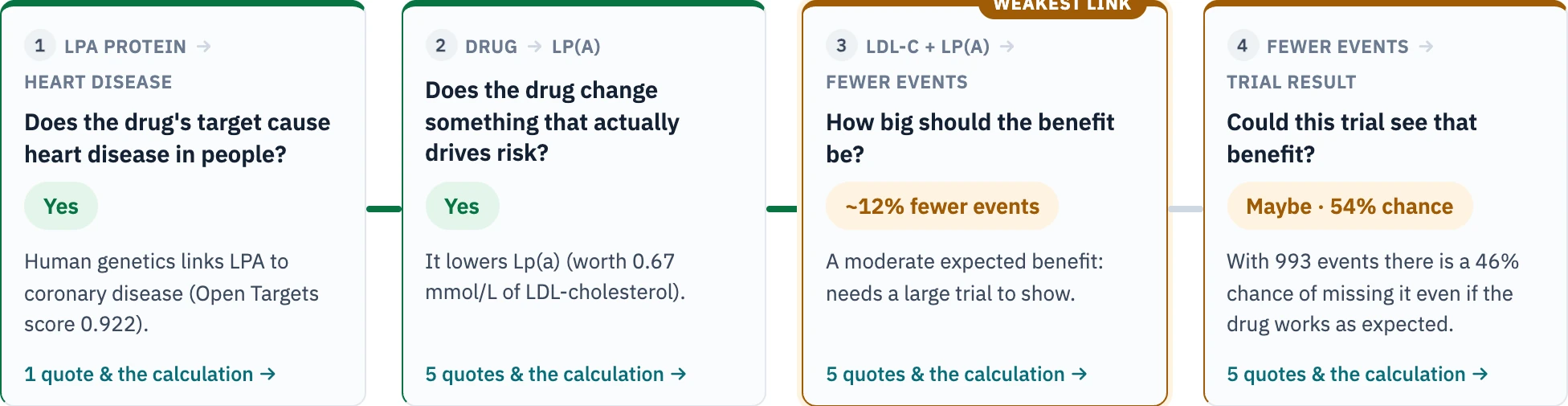
The causal chain for pelacarsen: target, drug, expected benefit and trial size.
Under the hood
Agents that check each other
A multi-agent pipeline: an investigator, an analyst, a calculator, a Verifier and a critic. The critic can send work back. In the dal-OUTCOMES case it caught a follow-up time the analyst had misread.
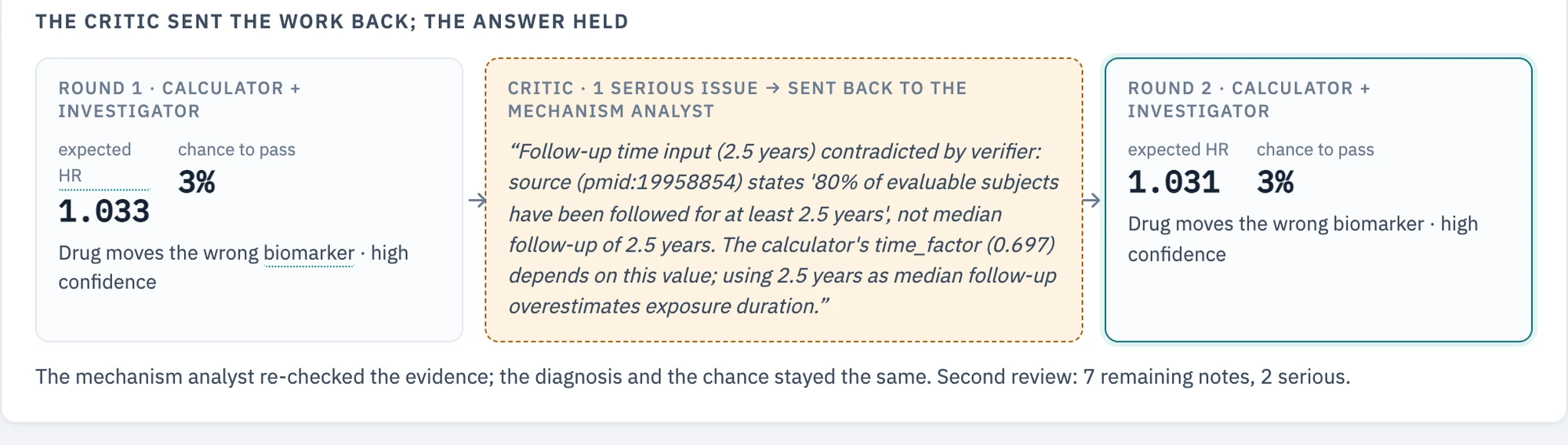
The critic sent the work back; the answer held after the second review.
The models are NVIDIA Nemotron, run through Meterless Nightshift. ClinicalTrials.gov, Europe PMC literature and SEC EDGAR filings are read through Zetaris as REST session tables with SQL on top, and facts are stored in the Meterless World Model engine (conformance 8/8).
A blind-test “time machine”: the evidence cut-off date is a WHERE clause in the Zetaris SQL, so a paper published after the cut-off never reaches the agents.
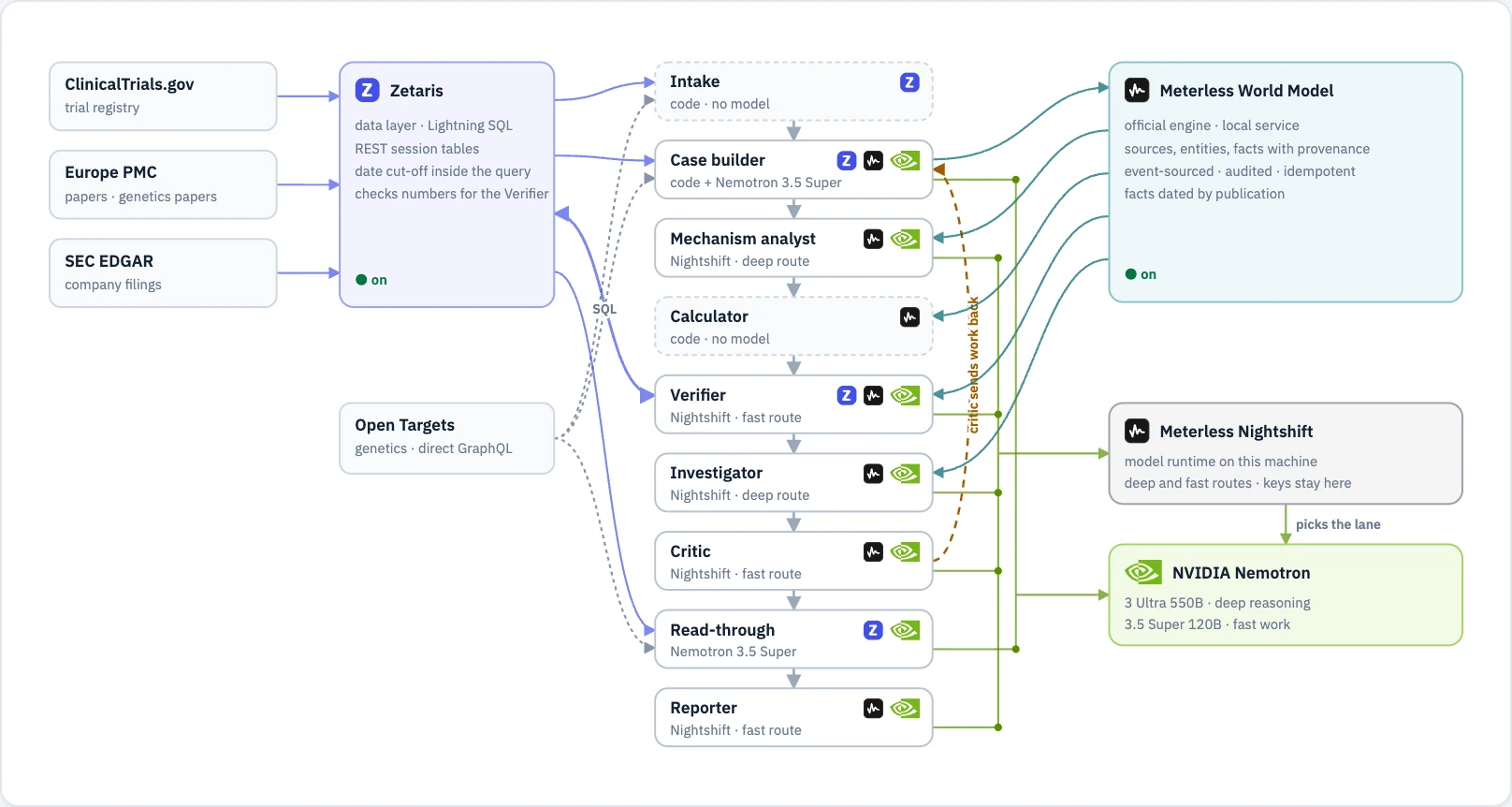
System map.
The Verifier
No quote, no number
Nemotron writes one SQL query per number. Code allows only a single SELECT, and Zetaris runs it against the original source. A number with no matching row is never confirmed.
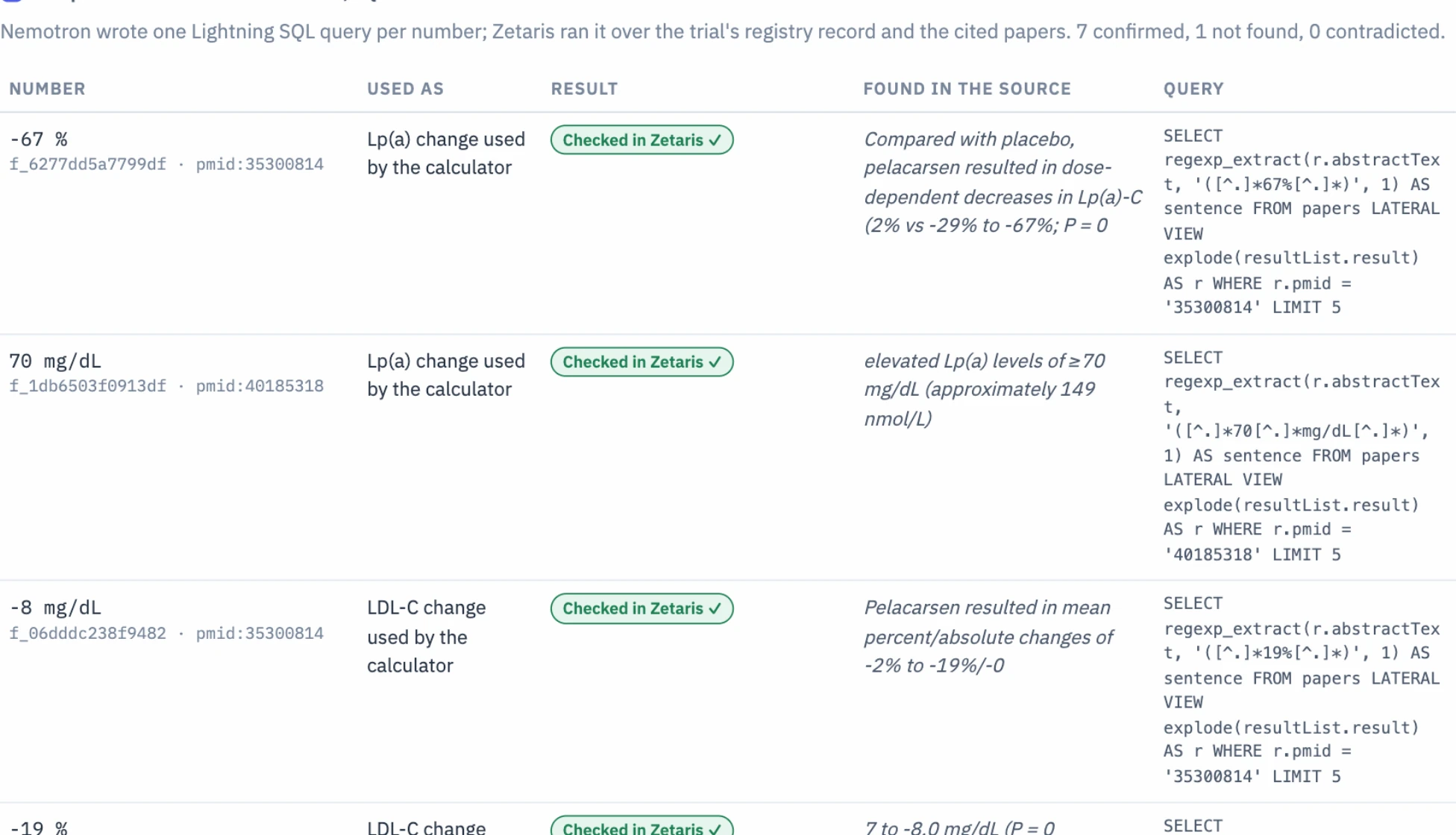
Results · blind backtest
Tested on 36 finished trials
Each case used only documents published before that trial’s readout, and was scored against later expert explanations.
On the post-freeze trials the success or failure forecast was right in 1 of 1 sizeable case. A pre-registered forecast for pelacarsen (commit fb6efd6) will be checked against the full data at AHA on 7 November 2026.
When things break
It fails honestly
01
No number, no forecast
A missing value is never read as zero.
02
Cut calls are retried
Every retry is logged; after two cuts the app calls NVIDIA directly, and the log names the provider that answered.
03
Sources get replaced
On 24 October 2026, when Europe PMC returned 503 all day, search switched to PubMed by itself.
04
Unverified is labelled
If Zetaris is down, the report says its numbers were not independently verified and lowers its confidence.
05
Out of scope is refused
Requests outside cardiovascular trials are refused, with the reason.
06
Runs offline
The whole system runs with no keys via docker compose up --build.
See it
Demo, deck and code
Built for
Open Agent Hackathon 2026
Built solo for the Open Agent Hackathon 2026, track “The Agent That Can Explain Why”, and submitted on 27 October 2026. It is also entered in the Zetaris Demo Challenge with a separate 2:37 video. No results have been announced yet.
Stack: Python and FastAPI on the backend; vanilla HTML, CSS and JavaScript on the frontend; Docker, GitHub Actions CI, deployed on Render. Sponsor technology: NVIDIA Nemotron, Meterless Nightshift, Meterless World Model, Zetaris, and Cursor for development.
Research tool. Not medical or investment advice.