CurrentSky · Moving-object finder for IASC
Where to look, before you blink
Finds moving asteroids in Pan-STARRS image sets from the International Astronomical Search Collaboration (IASC) and ranks them, so a person checks a short list instead of blinking a whole field by eye.
The problem
Blinking a whole field by eye
In an IASC campaign each image set is four photographs of the same patch of sky, taken about 18 minutes apart. Asteroids show up as dots that move in a straight line from frame to frame.
Volunteers find them by flipping (“blinking”) the frames in Astrometrica and scanning a field of 2423 × 2434 pixels by eye, tile by tile in a 4×4 grid. Blinking is where nearly all the time goes; measuring an object takes about a minute.
Most moving dots are noise, satellite trails or chip artifacts. The IASC Signature Guide exists to tell them from real asteroids.
How it works
From four frames to a short list
01
Load and align
Read time and sky coordinates from the FITS headers, mask chip gaps, remove the background and align the four frames (residual 0.15–0.62 px).
02
Link what moves
Drop everything that stands still and link what is left into straight tracks across 3 or 4 of the 4 frames.
03
Score by the Signature Guide
Straight line, constant speed, steady brightness, star-like shape, not a satellite, not on a gap, bright enough.
04
Name and rank
Refine the sky solution against Gaia DR3, look up known asteroids with SkyBoT, then rank the survivors by score.
One IASC image set: the zip as IASC sends it, or the four FITS files, dropped onto a web page.
- A ranked list of candidates
- Each track, with the pixel position in every frame, so you can click straight there in Astrometrica
- Speed, direction, brightness spread, signal-to-noise and score
- Known asteroids named and coloured by orbit class
- The tracks the filters rejected, so the filters can be judged, not only trusted
The workspace has a blink player for the four frames, a track overlay, frame stepping, zoom and drag, and a table of every candidate with all its measurements. The tool only searches: measurement in Astrometrica and the report to the Minor Planet Center stay with a person.
Under the hood
Demote, don’t delete
Classical image processing, with no neural network: one Python module per stage (io, preprocess, detect, register, link, filters, astrometry, known, render).
Every Signature Guide rule is also a soft score, so borderline objects are demoted, not deleted. A false candidate costs a glance; a missed asteroid is gone. The shape test compares a candidate with the stars of its own frame instead of a fixed number, because focus drifts between exposures.
Pan-STARRS 1
Image data distributed by IASC to campaign participants. GPC1 camera, 45 s exposures, about 10.3 × 10.4 arcmin per frame.
Gaia DR3 + SkyBoT
Gaia stars refine the sky solution; SkyBoT (IMCCE) names the known asteroids in the field. Both queries are cached and retried.
Python 3.12
numpy, scipy, astropy, photutils, astroquery and Pillow, about 3,900 lines in total.
Flask workspace
A local web app with a macOS launcher. Nothing is deployed.
Results
Tested on five practice sets
The answer key is every known asteroid brighter than V = 22 on the detector, taken from SkyBoT.
Per set: XY25_p10 4 of 4, XY26_p01 1 of 1, XY42_p11 2 of 2, XY15_p01 0 of 2, XY14_p10 none in the field. The two misses, 2015 VF175 (V 21.4) and 2014 HO19 (V 21.6), sit at the noise floor of these exposures: the nearest detection reaches signal-to-noise 3.8 and 2.6 and is absent in half the frames.
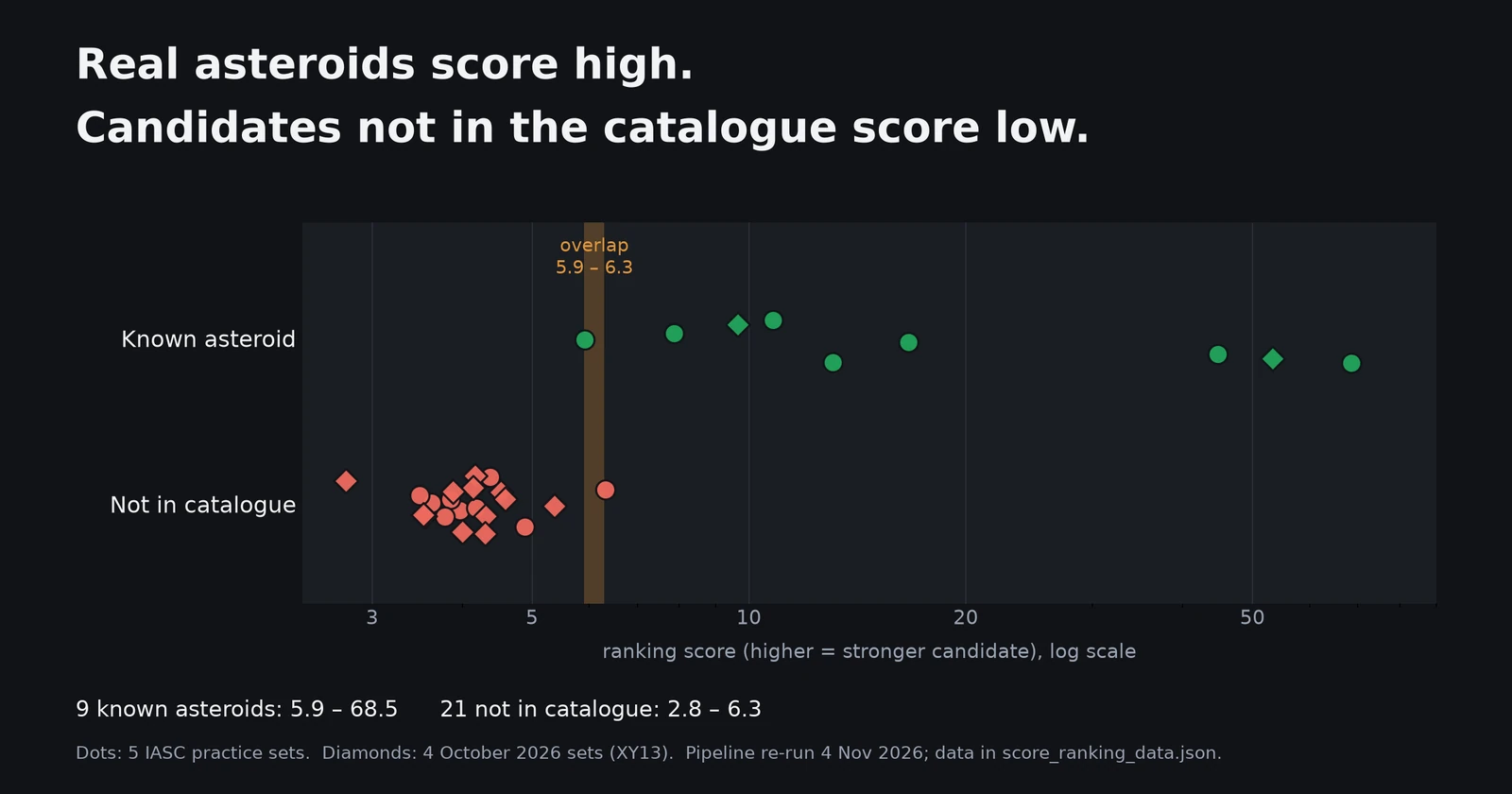
Known asteroids scored 5.9–68.5, candidates not in the catalogue 2.8–6.3. The ranges overlap between 5.9 and 6.3, so the ranking does not separate them cleanly.
The detection threshold was lowered to keep faint real objects, so the false candidates sit at the bottom of the ranking. With 9 objects, this shows that the pipeline works; it is not a recall statistic.
On real campaign sets. On 7 image sets from October 2026 the tool found three known asteroids, each on 4 of 4 frames: 2003 UJ156 (score 53.3), 2007 AW14 (22.9) and 2008 KU33 (9.6). They are already catalogued, so they are not discoveries. The 27 other candidates scored 2.7–5.6 with signal-to-noise 2.5–4.1 and are almost certainly noise. No new asteroid was found.
Not measured: how much time the tool saves compared with blinking by hand. The only measured number is the run time, 8–12 seconds per set once the Gaia query is cached.
Limits
A hint, not a verdict
01
Every candidate is checked
Each one must still be checked in Astrometrica against the Signature Guide and the comparison with the catalogue.
02
Faint objects are missed
Objects at the noise floor (about V 21.5 and fainter here) and objects lost in chip gaps or at the frame edge.
03
Falls back, and says so
If the Gaia fit is poor, it uses the header sky solution, and the workspace shows which one is in use.
Search aid only. Candidates must be checked in Astrometrica; nothing here is an MPC measurement.
Built for
IASC Asteroid Search Campaign
Built by Stanislav Gatin for the IASC International Asteroid Search Campaign of 6–30 October 2026, where citizen-science teams find moving objects in Pan-STARRS images and submit measurements to the Minor Planet Center. It is a working prototype that runs locally.