CurrentSky · AI agents that check viral photos
Real photo, wrong story?
AI agents on Meta’s models that find where a viral photo or video appeared online before, date every copy, and tell you whether its caption fits.
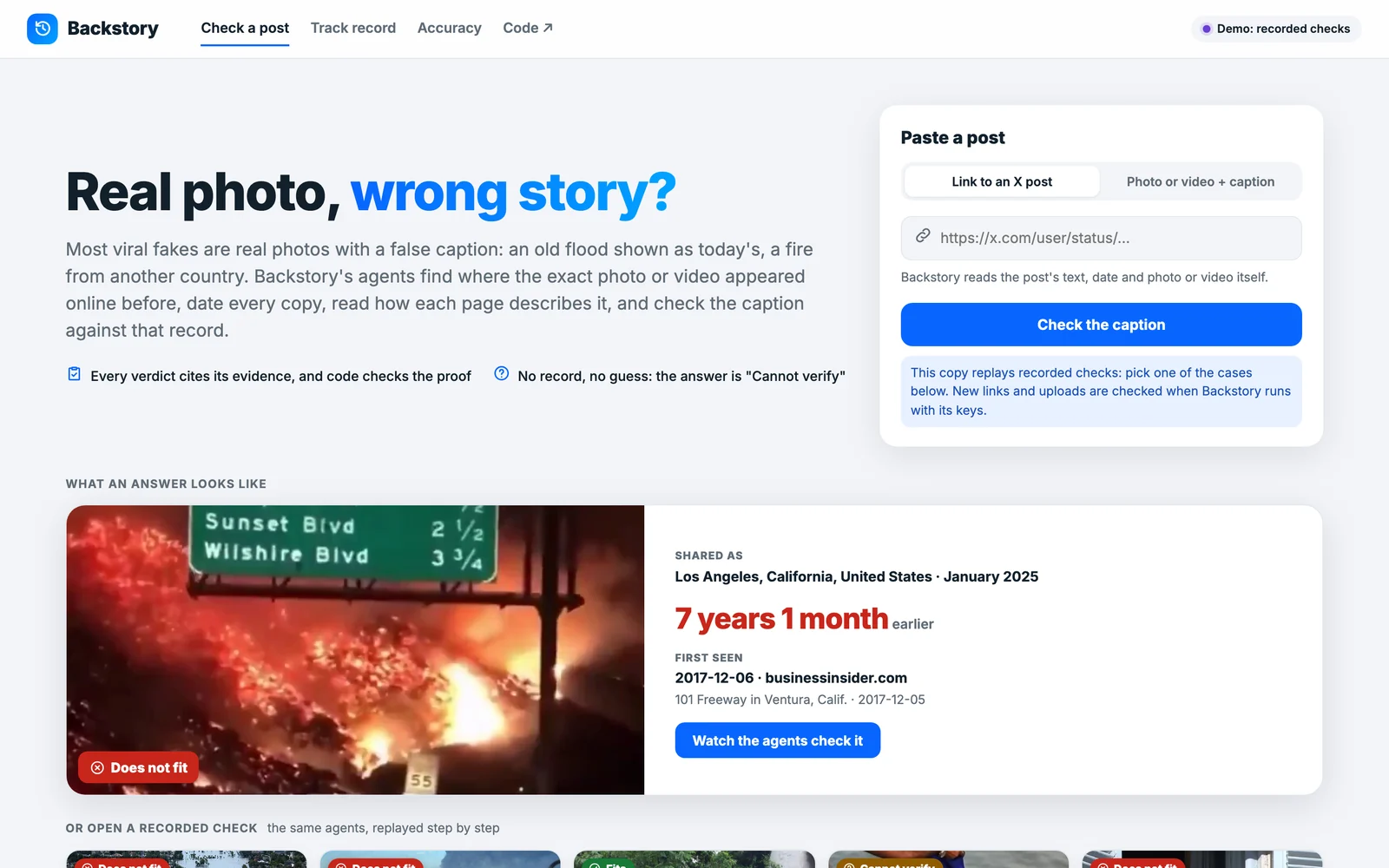
Frame from a post on X, January 2025. Footage of the December 2017 Skirball Fire, Los Angeles.
The problem
Real pixels, wrong caption
Many of the photos that spread fastest after a disaster are real, but from another time or place. The pixels are genuine, so a detector for edited or AI-made images sees nothing wrong. What is wrong is the caption.
On 10 January 2025 a video of a freeway lined with flames was shared on X as the Los Angeles fires. It is footage of the December 2017 Skirball Fire beside Interstate 405. Backstory found the same footage in a Business Insider article published on 6 December 2017: 7 years 1 month earlier.
Fact-checkers and Community Notes writers find the older copy by hand, which takes from minutes to hours per post.
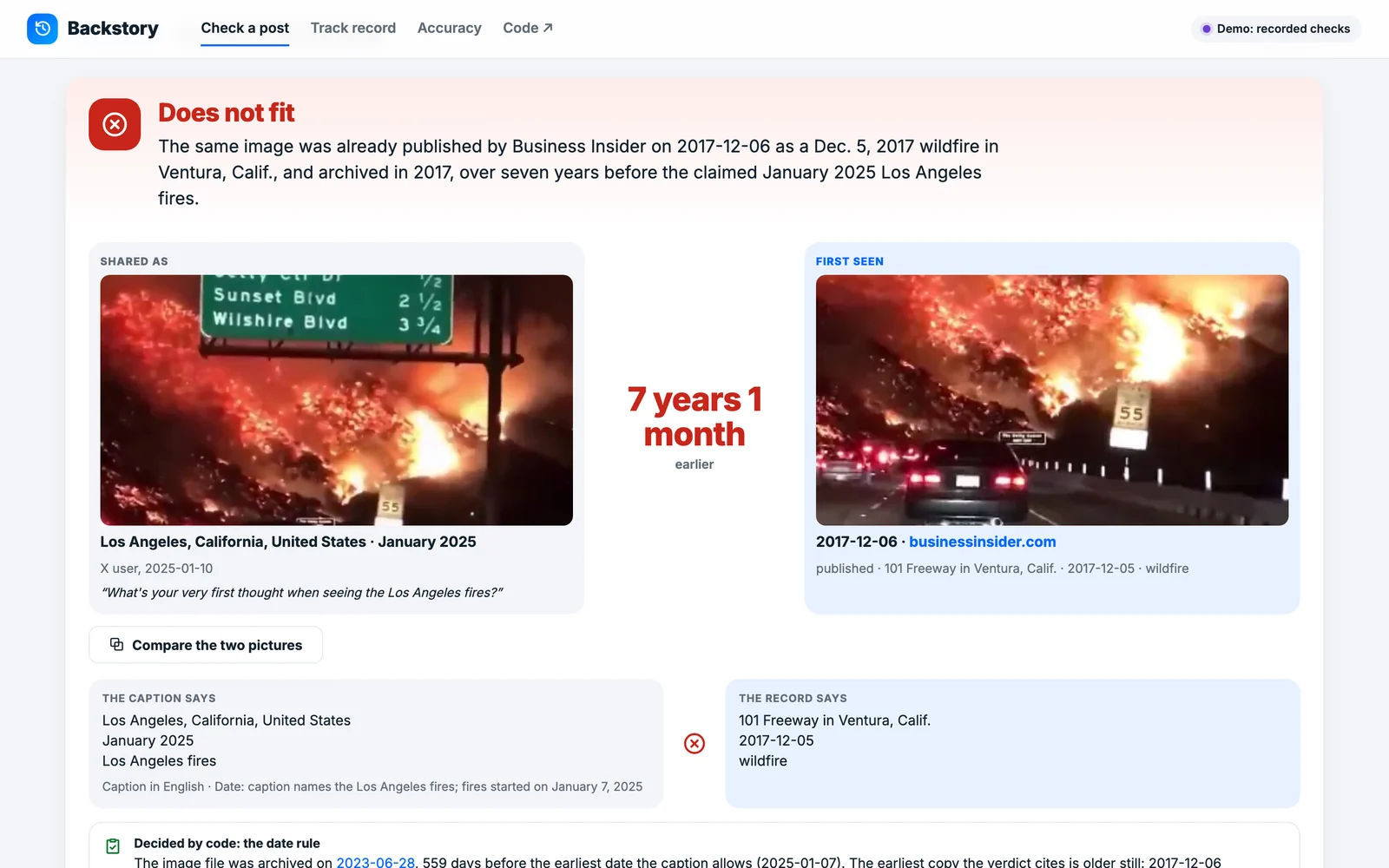
Frame from a post on X, January 2025. Footage of the December 2017 Skirball Fire, Los Angeles.
How it works
Read, search, decide, prove
01
Read the post
Text, date and media from the link. For a video: four still frames, the speech transcribed, and the signs in the scene read.
02
Find its past
Reverse image search, exact posting dates of copies on X, TikTok and YouTube, the first Internet Archive capture of each page, and what each page says the photo shows.
03
Decide
A date rule in code, then a judge model that must cite rows of the evidence table, and a critic that checks every citation and can send the judge back once.
04
Check the proof
Code accepts “Does not fit” only if the table holds real proof. Otherwise the answer becomes “Cannot verify”.
A link to a post on X, or a photo or video with the caption it was shared with.
- “Does not fit”, “Fits” or “Cannot verify”, with the evidence
- The post next to its first copy online and the time between them
- A timeline of every dated copy
- A draft Community Note
- A receipt of every model call, with tokens and cost
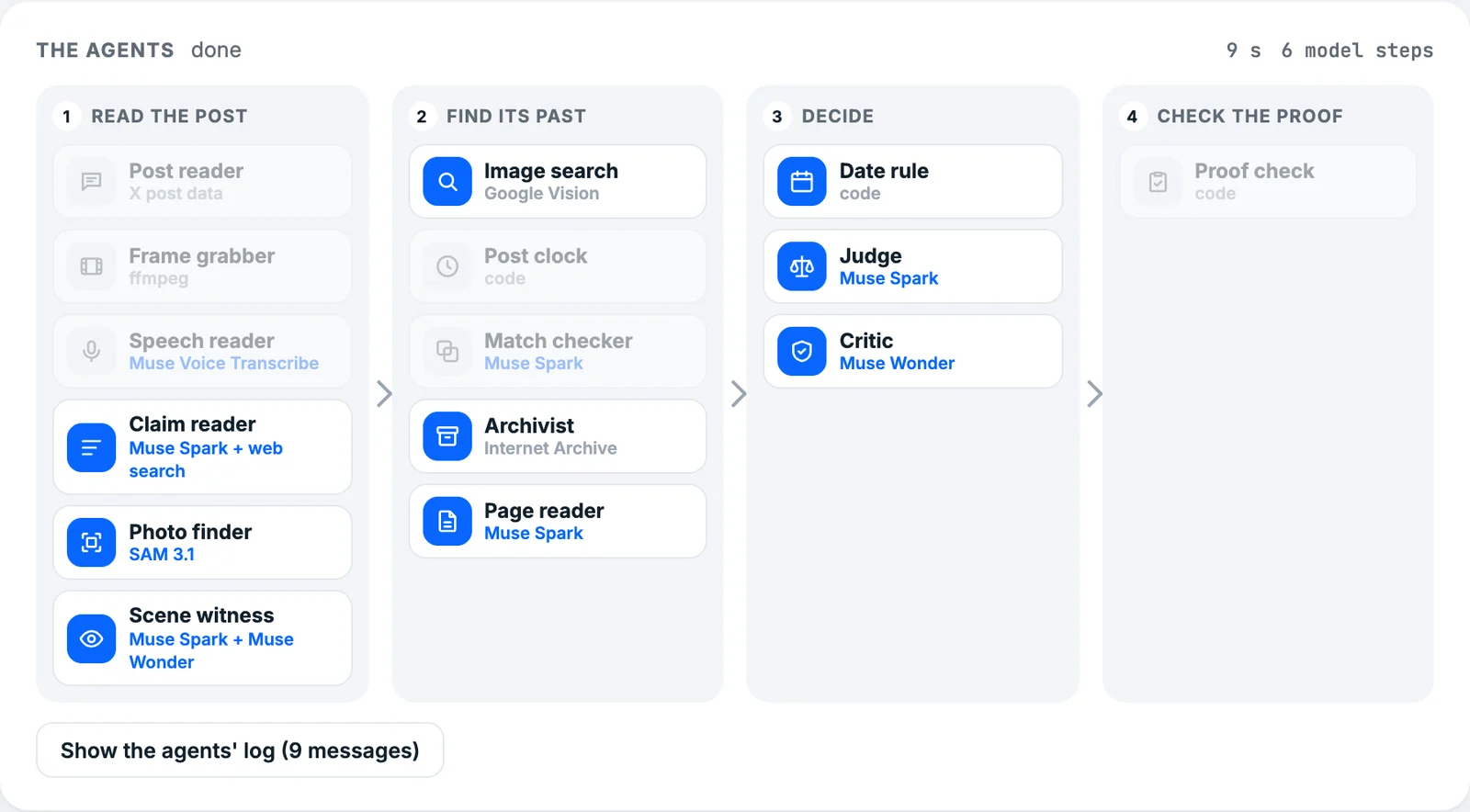
15 steps in four stages, 8 of them on Meta’s models.
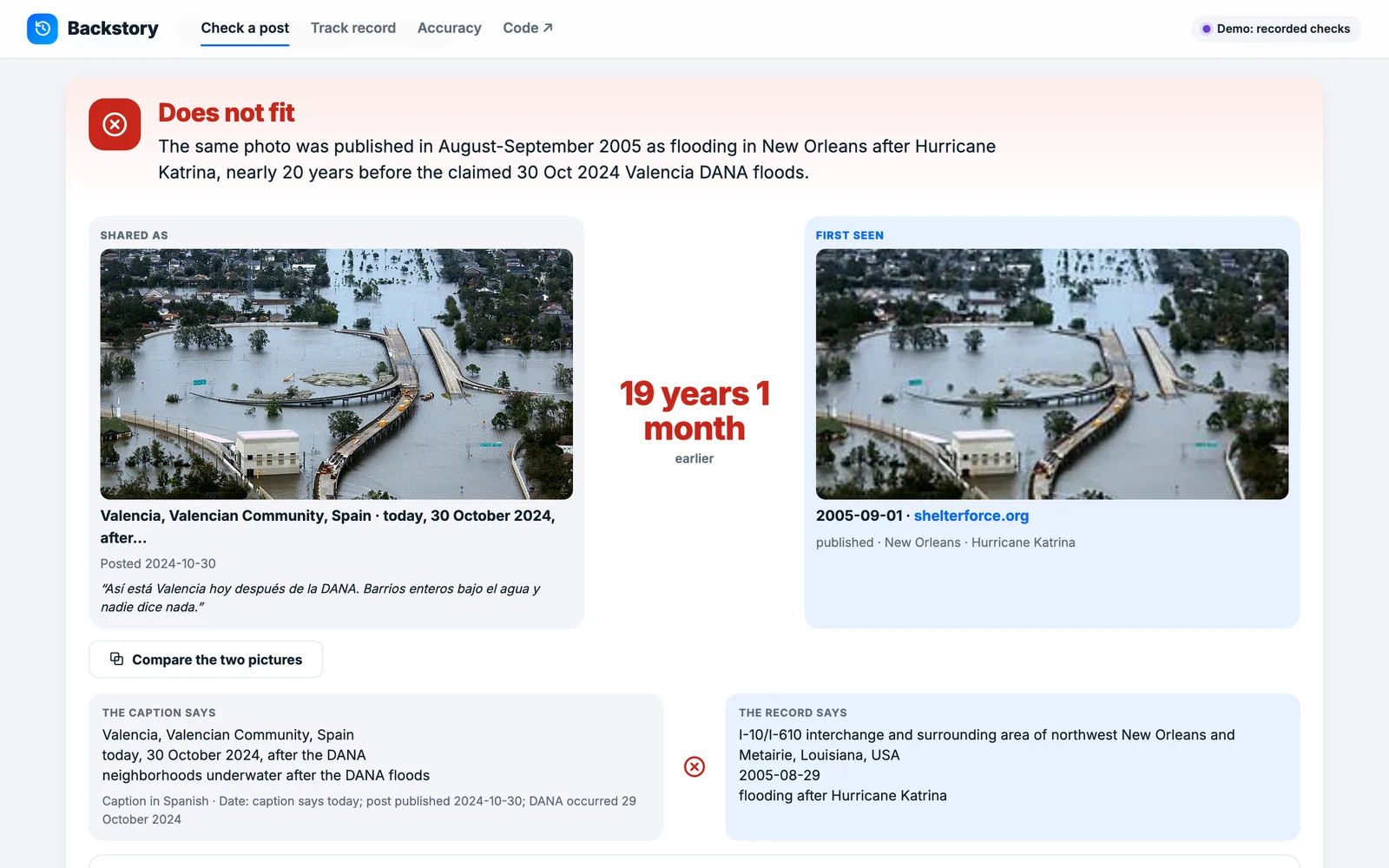
A staged example: a 2005 Hurricane Katrina photo captioned as the 2024 Valencia floods. Public-domain photos (U.S. Coast Guard).
Under the hood
Models read. Code decides.
Models read, compare and judge, but code has the last word on what counts as proof: no record, no guess. Proof is a copy of the same image dated more than 7 days before the claim, two independent sites that describe it differently, or a confirmed sign in the scene that names another country.
Muse Spark 1.3
Claim reader with web search, match checker, page reader, judge, and the scene witness that watches the first minute of a video.
Muse Wonder 1.0
The critic, and a second look at every place-naming sign the witness reads. The stronger model checks the cheaper one.
Muse Voice Transcribe
What is said in a video counts as part of the claim.
SAM 3.1
Cuts the separate photos out of a screenshot or collage, so each one is searched too.
Outside Meta: Google Cloud Vision for reverse image search, the Internet Archive for dates, and ffmpeg for frames. Every external answer is recorded by a hash of its request, so recorded checks replay offline to the same verdict.
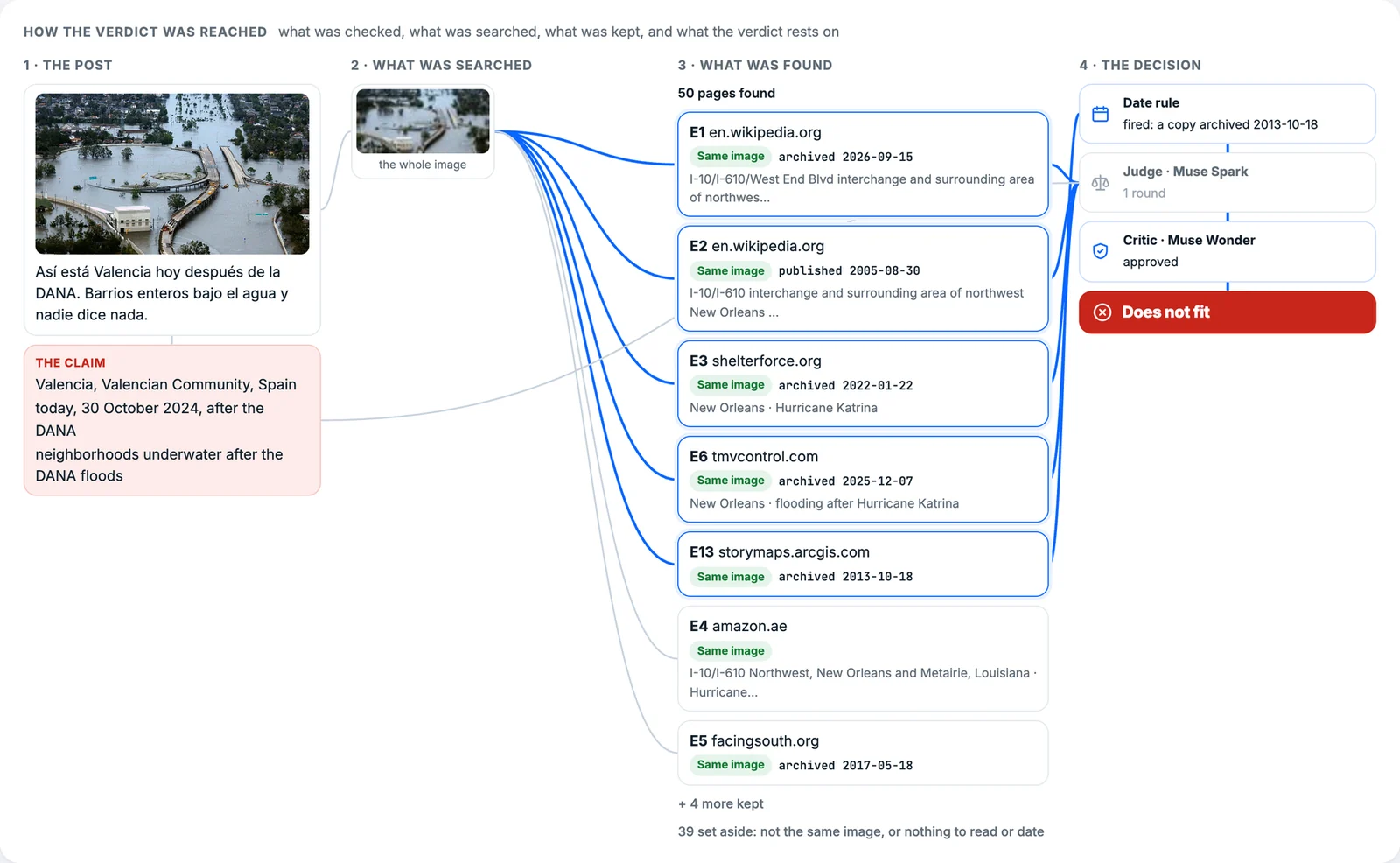
How the verdict was reached.
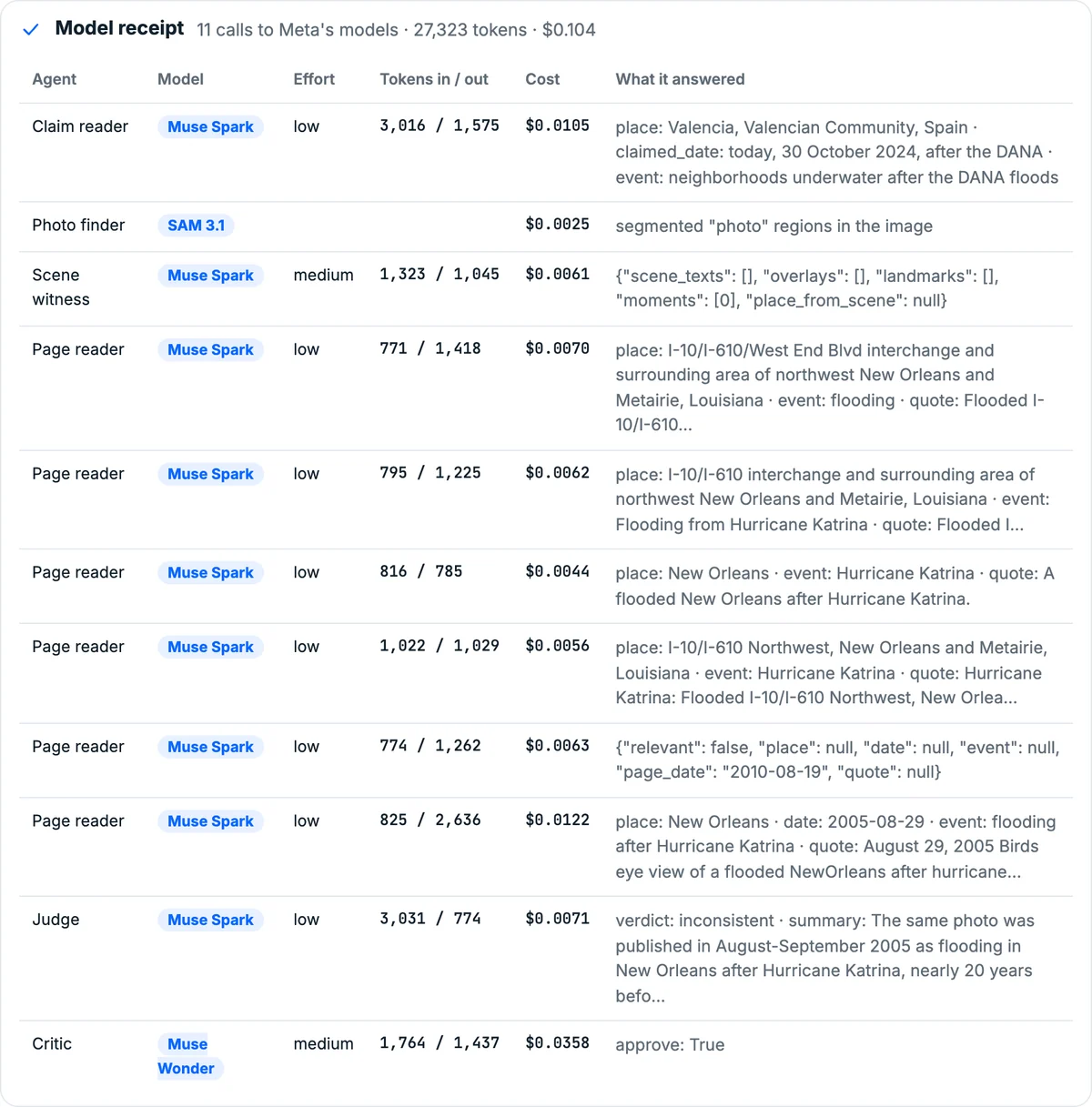
The receipt: every model call, with tokens and cost.
Results
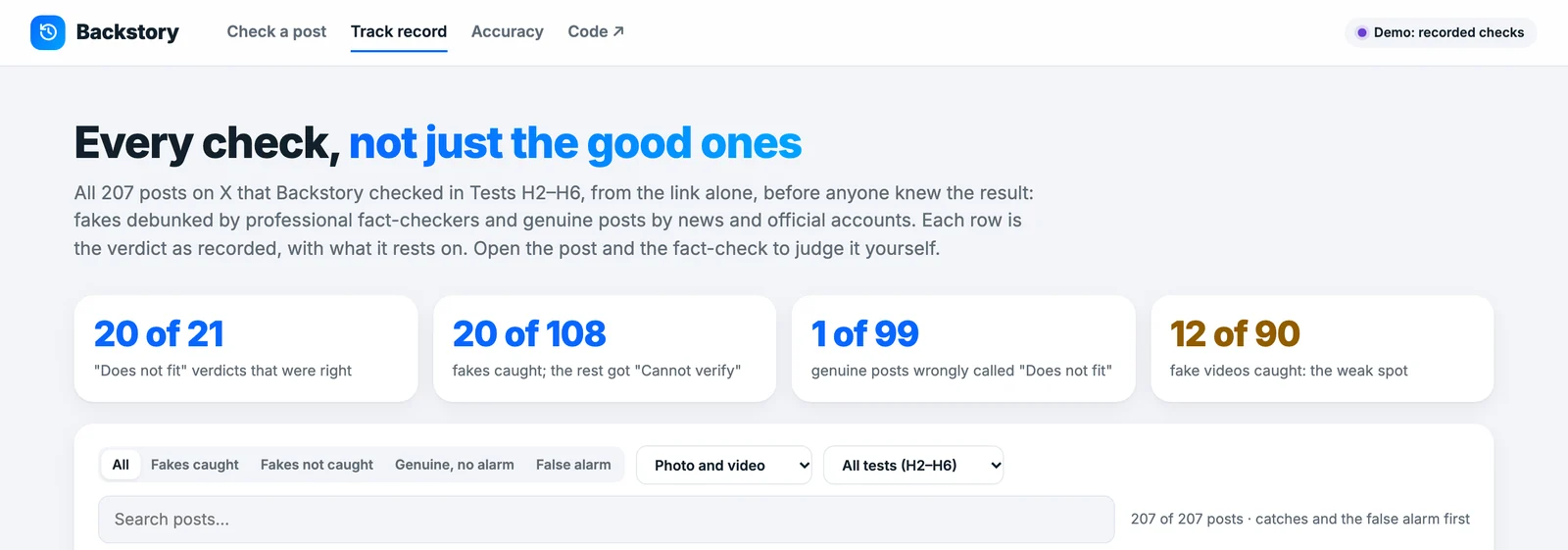
Tested on 207 real posts
Checked from the link alone. Each of the nine tests had its pass rule written before the run, and several failed their own rule. Those failures are published too.
Most fakes get “Cannot verify” because reverse search finds nothing usable for most fake videos. It answers only when it has proof.
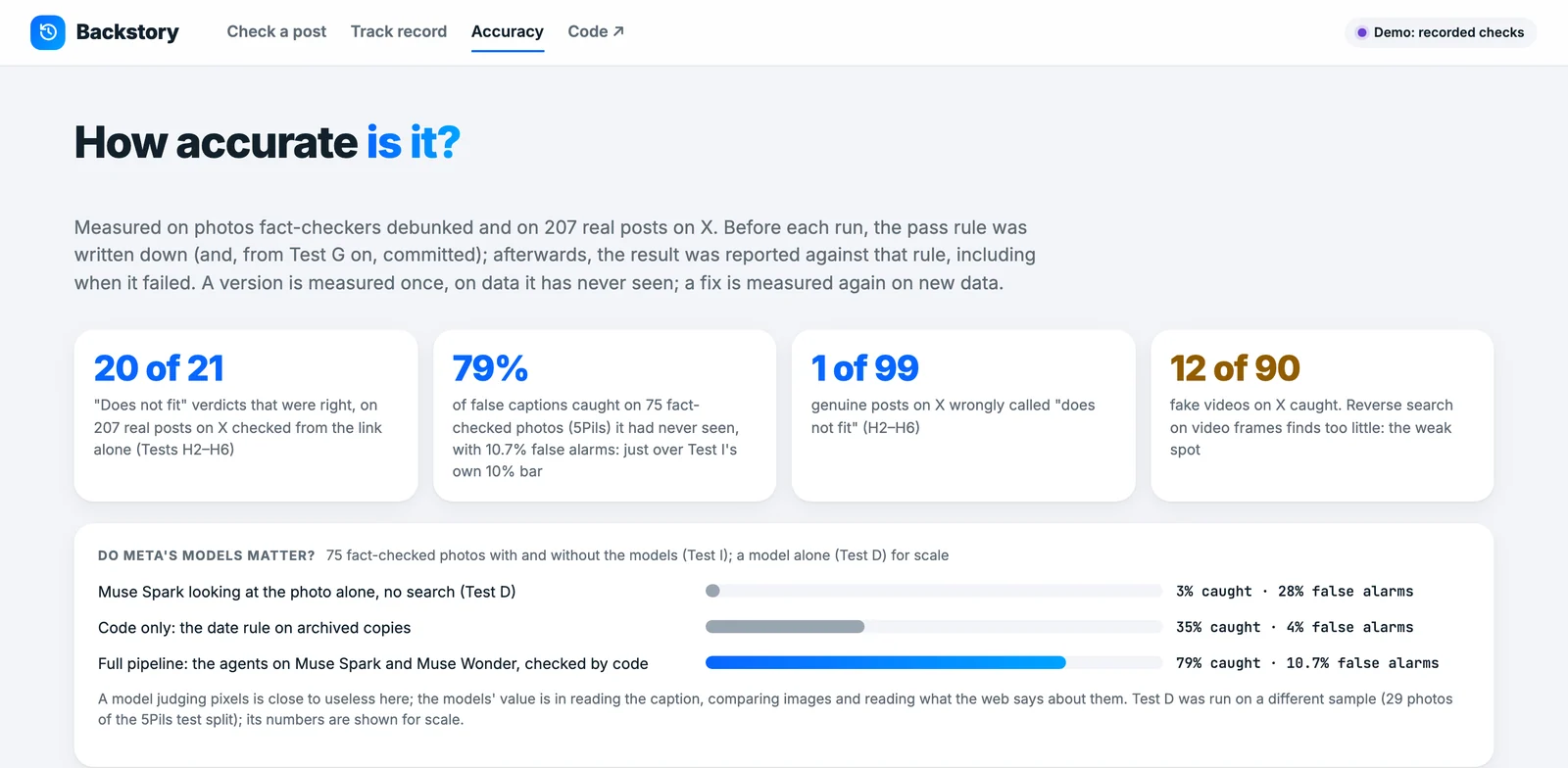
Do Meta’s models matter? On 75 fact-checked photos it had never seen, plain code alone caught 35% of false captions with 4% false alarms. The full agent pipeline caught 79% with 10.7% false alarms. Muse Spark looking at the photo alone, with no search, caught 3% with 28% false alarms, on a different sample of 29 photos.
A look at current posts: 10 viral fakes from October 2026, debunked by fact-checkers and checked live from the link. It caught 4 and said “Cannot verify” on 6. This was not pre-registered, so it is not a measurement.
Limits
It says when it cannot tell
01
No past, no verdict
With no earlier copy online the answer is “Cannot verify”, with the reason. Fabricated or AI-made images have no past and get the same answer.
02
Disagreement stops it
If the judge and the critic still disagree after one send-back, the answer is “Cannot verify”.
03
One failure is not fatal
A page that will not open, an archive lookup that times out, a frame that cannot be searched: the rest still count, and the table says so.
04
Model fallback is named
When Muse Spark 1.3 answered “model not found”, calls went to Muse Spark 1.2 at the same price, and the receipt names the model that answered.
05
It cannot copy the answer
The X Community Note is never shown to the agents, and fact-checking sites are removed from search results.
06
Runs are reproducible
Models vary between runs. The critic and the proof check narrow this, and recordings replay every check the same way.
Not a fake detector. Backstory checks the captions of real photos and videos. It does not detect edits or AI-made images.
See it
Check a post yourself
Built for
Meta Global AI Developer Hackathon 2026
Built solo in ten days for the Meta Global AI Developer Hackathon 2026 (Meta and Cerebral Valley), Indie Developer track, theme “Build for Your World”.